Summit Equipment Service
Expertise Across All Major Brands
Contractors don't just hire a repair service — they hire the person showing up. Here's who's on the other end of that phone.
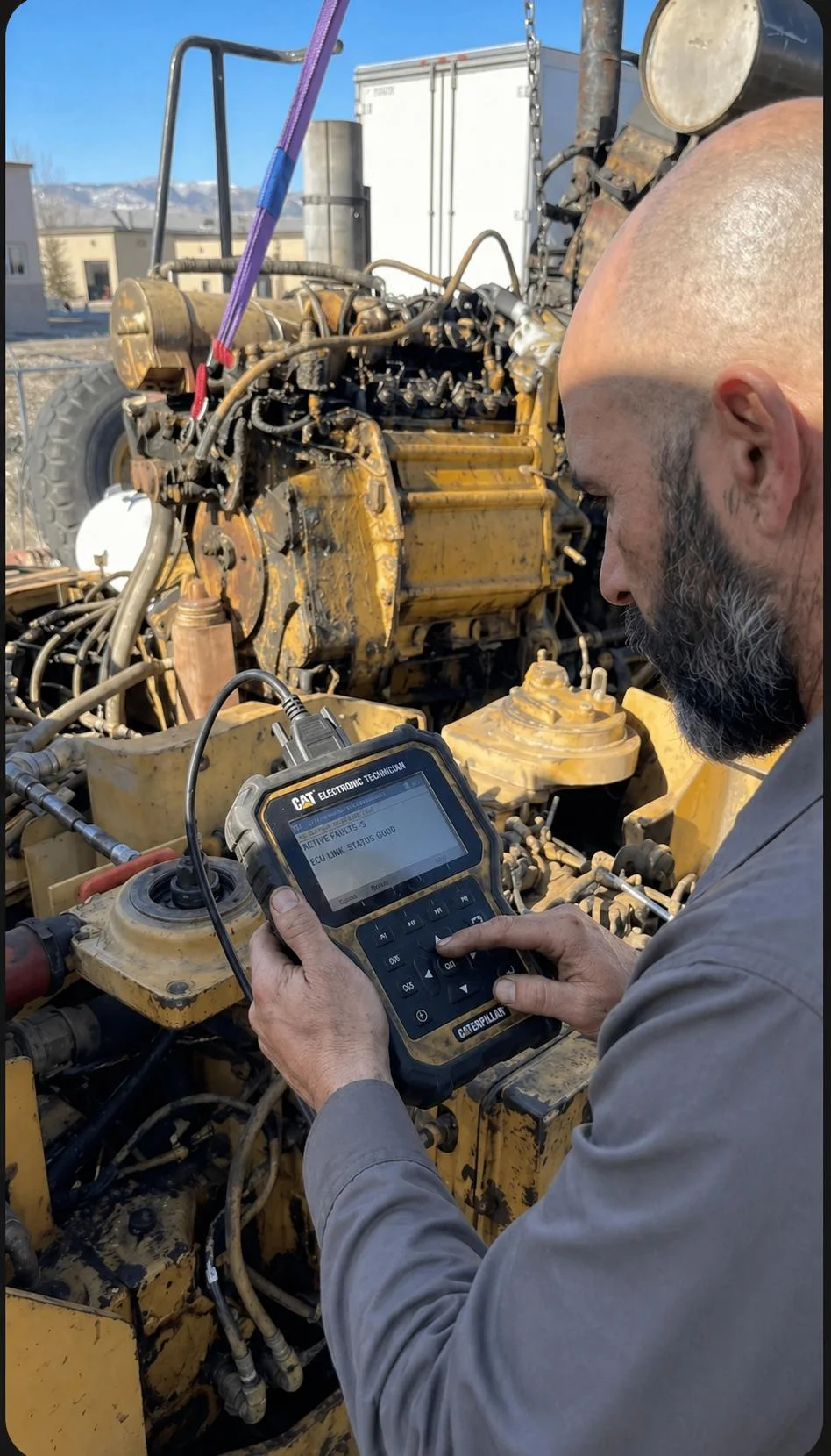
I've been working on equipment and mechanical systems for around 30 years now, with the majority of that focused on heavy equipment and field service.
"I've spent a big chunk of my career doing diagnostics and repairs in real-world conditions — not in a shop, but out on job sites where downtime actually matters."
That field experience is real and extensive. As a field service mechanic for Altec Industries, I traveled 300+ days a year across the midwestern U.S. and Alaska, handling everything from routine repairs to coordinating boom-section replacements across state lines. The kind of work where logistics, judgment, and follow-through matter as much as wrench time.
I've also run the shop side of the business. As a Service Shop Foreman at H&E Equipment Services, I coordinated repairs for ten to twelve field and shop mechanics, managed accounts receivable, warranty tracking, and work safety — alongside running my own bay full of machinery in various phases of repair. Today at Summit Equipment Service, I'm the Lead Field Mechanic — coordinating other mechanics, managing invoices, training, and parts.
I've also spent time training and guiding other mechanics, especially when it comes to diagnostics. Anyone can throw parts at a problem. Knowing how to actually test a system and prove what's wrong is an entirely different and much more demanding skill set. It's a skill set that is getting very difficult to find these days.
I've also been a technical trade instructor at a technical college — my specialty was hydraulics, and I taught the ASE Diesel (T2) prep course. 95% of my students passed the ASE exam on their first attempt. I scored 100% on that same ASE exam myself. I started Summit Equipment Service to take that approach directly to customers.
Real training, real certifications, real track record. Not a list of buzzwords — verifiable, factory-level credentials backing up every job.
I've always been wired toward figuring out how things work. Mechanical systems made sense to me early on — especially the kind where multiple things interact and you have to actually think your way through a problem.
What pulled me into heavy equipment specifically was how real the consequences are. When a machine is down, someone is losing money immediately. There's no room for guessing or "we'll see if this fixes it." You either diagnose it correctly or you don't.
"That pressure is what I like about it."
I started Summit because I saw too many contractors getting burned by slow, inconsistent, or guess-based repairs.
"That doesn't work when you've got a machine sitting dead on a job. I absolutely have to solve problems. And I do."
My background is heavily experience-driven, but I've also invested in professional diagnostic tooling and training that most independent techs don't carry.
I use a TEXA diagnostic platform for heavy equipment and trucks, which allows me to interface directly with machine control systems across multiple manufacturers — most often on a dealership level.
Beyond that, my focus has been on real-world diagnostic methodology: fuel systems, hydraulics, electrical systems, aftertreatment systems — tested and verified on actual machines, not just theory. I also handle welding and fabrication on-site when the job calls for it, which keeps a lot of repairs from turning into tow jobs.
"I don't rely on guessing or parts swapping. Everything I do is based on measured data and confirmed faults."
My factory training has been hands-on and engineer-conducted — including two months of intensive training at the Altec Industries factory in Saint Joseph, Missouri (covering high-tension dielectric testing, wiring harness design, proprietary electronics, and specialty hydraulic components), engineer-led tear-down training at National Crane in Omaha, NACCO/Yale Lift Trucks factory school in Greenville, SC, and Genie Super Boom factory training. I have advanced courses with Genie, JLG, Caterpillar, Komatsu, Yale, Hyster, Case, Altec, Bobcat, National, Honda, Mack, Volvo, and Kubota, among others.
Cranes, forklifts, manlifts, excavators, generators, light trucks, refrigeration systems — I'm not locked into one brand or one machine type. The advantage of how I work is I can step into almost any piece of equipment and figure it out.
"At the end of the day, systems are systems — whether they're hydraulic, electrical, or fuel — regardless of the badge on the machine. I specialize in diagnosing how they're interacting. I thoroughly understand systems."
"Contractors call me because I actually figure out what's wrong, with zero runaround. Not guess. Not throw parts at it. Not waste their time."
When I show up, I'm there to diagnose the problem, explain it clearly, and get the machine back to work as quickly as possible.
Customers also know I'm going to be straight with them. If something's simple, I'll say it. If it's serious, I'll say that too.
No runaround. Just answers and results.
Great mechanic service. Thorough, quick and knowledgeable.
Brought Shane out to diagnose a CAT D6 LGP Crawler that was throwing sensor faults and ECU errors and going into derate. A previous mechanic had already looked at it and couldn't find the issue. Shane tracked it down fast – the problem was resolved with a replacement sensor and forced regeneration.